
I run delivery so builders can build.

Clarity from chaos. Simplicity from sprawl. Transparency throughout.
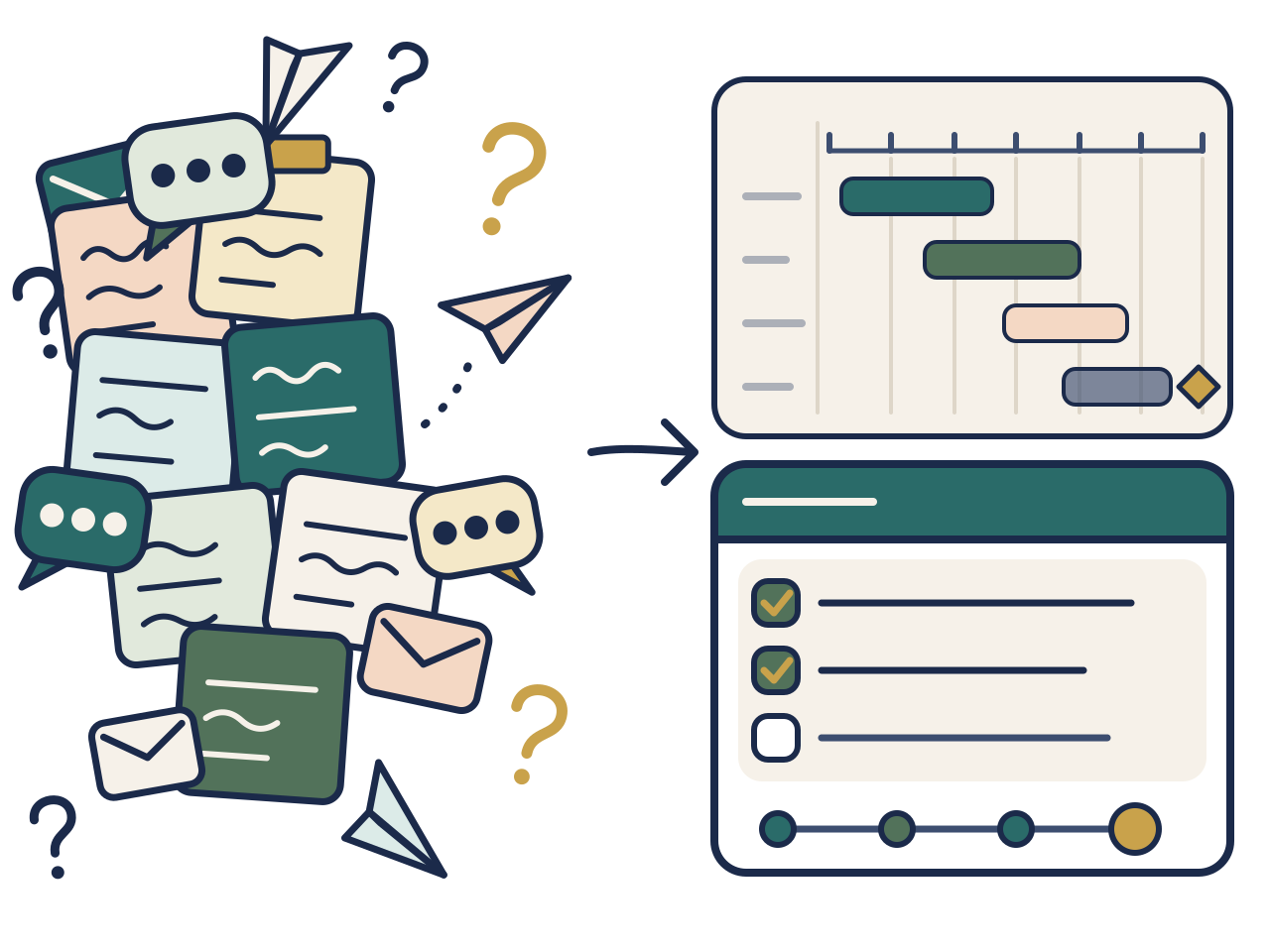
Messy sticky notes, chat bubbles, paper airplanes, and question marks turning into a clear project plan and timeline.

About StrigidPM

Builders do their best work when they can focus on building.

Managing clients pulls your attention away. You end up translating messy feedback, chasing sign-offs, writing updates, and sitting in meetings.

I get you back to building by starting with what your client actually needs: the real business problem, why it matters now, and what success looks like now and a year from now. I turn those answers into clear requirements you can build from. When you deliver, I translate the result into plain language so your client can understand it, approve it, and run it long after the project ends. AI runs through my whole delivery process, so the work moves faster and fewer details get dropped.

Bring me in at the start and everyone is on the same page from day one.

Bring me in mid-project, when delivery is slipping or the client is losing patience, and I'll find what's going wrong and put a plan in place to get the project back on track, so you can put your focus back on the technical work.

Ready for me to manage client delivery for you? Book a Fit Call.

It’s a free conversation where you tell me what you’re building and where client delivery is getting hard. I tell you whether I can help and we both decide whether we want to work together. I don’t pitch you or diagnose your project on this call.

Two phone headsets facing each other, each with a speech bubble

Work with me

If you build websites, apps, or software for clients, there are two ways you can work with me.

One-off project

I manage a single project from the client's first ask to launch and handover.

I manage delivery from the first ask to handover: agreeing on the solution, planning, keeping the client updated, and handing it over with a walkthrough and the documentation your client needs. When it's done, you have the requirements, the plan, and the documentation to run the next project yourself.

Right for a single client project, whether it's about to start or already underway.

Fractional

Your ongoing project management lead.

I join your team on an ongoing basis and manage delivery across your clients and projects: the requirements, the schedule, and client communication. You get one person who keeps the work to what was agreed and tells you early when a date is at risk.

Fractional also covers:

  • Project management. I manage each project from first ask to handover.
  • Strategy and planning. I turn your goals into a plan with priorities, owners, and dates, and keep it current.
  • Process and frameworks. I map how work runs today and build the delivery framework, procedures, and templates your team uses.

Right if you have a steady stream of client projects, or a shop that's growing faster than you can hold it together.

How AI fits in. AI runs through my whole delivery process, so the work moves faster and fewer details get dropped. That's how I keep the cost realistic for my clients.


How it works and what it costs

Every one-off project follows the same stages, from discovery through closeout. Hiring me as your ongoing project manager works differently; that's described below the stages.

Before you commit

0CallFit Call

A free conversation to see whether I'm the right fit.

  • You tell me what you're building and where client delivery is getting hard, and I tell you whether I can help.
  • I don't pitch my services or diagnose your project on this call.
  • If we both want to move forward, I send you the agreements and the Welcome Packet.

Not familiar with my work yet? Read about me below or subscribe to the newsletter first, then come back.

Free
1ACallDiscovery Scoping Call

Our first working session. We agree on your goal, what success looks like, and what's in and out of scope. The scope goes into your Findings Brief.

Before you pay, I send you the agreements to review. After you pay, you return the signed copies and the intake form within 5 business days.

$575paid at booking

Once we're working together

1BDiscovery & Diagnosis

A kickoff call, then a close look at how the work runs today and what's driving the need.

You get the Findings Brief:

What the project is, how things work today, what's causing the issues, and what I recommend next.

$2,875invoiced when I deliver the Findings Brief
Approval 1: Findings Brief

Accept the Findings Brief in writing, or it's accepted after 5 business days with no objection.Stage 2 starts only on your written go-ahead, within 30 days after the Brief is final.No go-ahead, no Stage 2 fee.

2Design & Planning

I design the solution and build the complete plan with you.

You get the Delivery Roadmap:

The recommended solution, the timeline, the change and training plan, and the budget for the stages that follow.

$3,565invoiced when I deliver the Roadmap
Approval 2: Delivery Roadmap

Accept the Roadmap in writing, or it's accepted after 5 business days with no objection.That doesn't commit you to Stage 3.If we go on, we sign the Client Services SOW.The estimated Stage 3 duration in the Roadmap is a target, not a guarantee.

3Setup & Execution

I coordinate the build and testing, which your team performs, and I train your end users.

You get:

  1. Testing plan and results: I write the test plan, coordinate the testing, and log the results. Anything that fails is logged, fixed, and retested. If something can't be fixed before launch, we log it and agree on a workaround.
  2. Deployment and cutover plan: step-by-step go-live instructions, including how to roll back.
  3. Training report and materials: a report of who completed training, plus materials to keep.
Light$3,980/mo
Standard$7,960/mo
Heavy$11,950/mo
Monthly. The Roadmap recommends a tier and your Client Services SOW sets it.Invoiced monthly in advance. Partial months are prorated.Stage 3 runs until you approve launch readiness in writing. The monthly fee runs until then.
Approval 3: Ready to launch

You confirm in writing that you're ready to go live.Every issue from testing is fixed or has an agreed workaround.If you're not ready, tell me what's still open within 5 business days.

4Launch & Handover

I coordinate the go-live and cutover and support the handover to your operations team, including one knowledge-transfer session.

You get:

Written confirmation it's live, plus plain-language user guides and operating procedures.

$1,035invoiced when I deliver, or 30 days after you approve launch readiness, whichever comes first
5Optimization & Close

I review the results against the success criteria in your Roadmap and close out the project.

You get:

A review report and a closeout package.

$920invoiced when I deliver, or 30 days after the Stage 4 invoice, whichever comes first

Hiring me as your ongoing project manager? After Stage 1B, we can skip Stage 2 and, if we both agree, sign a Fractional Services SOW at a monthly tier based on your Findings Brief. It runs month to month with no minimum term, and planning, launches, and closeouts for your projects happen inside it.

I don't bill by the hour. Invoices are due 15 days after the invoice date.

Ready to see whether we're a fit?

Be one of my first five clients

I'm offering my first five clients a discount.

  • One-off project: the discount covers the whole engagement.

  • Fractional: it lasts 12 months from your first monthly payment, if you sign the Fractional Services SOW within 60 days after your Findings Brief is final.

In return, I ask for a testimonial, a case study, and your OK to announce you as one of my first clients. You approve each one before it's published.More details are in your Welcome Packet.

Not sure what's derailing your projects?

Answer five questions. You'll get the most likely cause, recommended steps you can take today to improve delivery, and links to free resources.

A magnifying glass examining one bar on a project Gantt chart.

Who you'd be working with

Over 20 years, I've run delivery in fintech, quick-service restaurants, fleet technology, federal contracting, and workforce management. With that experience and my PMP, Prosci Change Practitioner, and Lean Six Sigma Green Belt certifications, I bring clarity and steady delivery to complex projects.

I love figuring out how all the pieces of a project fit together, building the framework that enables the team, and seeing the results out in the world. To me, the job is service.Here's how I think about it:

  • Respect the builders. The people building are the experts. I give them the problem with all its constraints, work with them to shape the solution, and plan around their capacity, dependencies, and development cycle.

  • Protect the client's outcome. Frameworks and plans only matter if they deliver value in the real world. I keep the work tied to what your client actually needs and translate both ways. Their goals become requirements you can build from, and your questions and options are made plain so they can make informed decisions.

  • Own project clarity. I want the team to do their job well, so I give clear direction, find the simplest ways of working, and stay completely open about what's going on and why. If anyone has to go somewhere else for a clear answer, I dropped the ball.


My track record

A strained client relationship and an issue backlog nobody ownedHow do you win back a client who has run out of patience?

The problem

A state transportation agency, one of a fleet technology company's biggest customers, was on a heavily customized legacy system. Support tickets had been open for weeks, months, even years, and fixing one issue often created new problems somewhere else. At one point, the client shut down fueling at its sites for a weekend until an issue was resolved.

What I did

I took ownership of reducing the issue backlog and repairing the client relationship at the same time.

Clarity. I learned the system first: what was customized, why, and which version they were on. Then I got support, software, hardware testing, and parts supply around one table to agree on one prioritized ticket list. I treated it as priority work, drove every firm due date, and asked my team for updates in person. I wanted a status even when the problem or the fix was still unclear: what we were doing about it, what we'd unwound, and what we needed from the client.

Simplicity. I set case management rules so repeat issues became updates to existing tickets instead of new ones.

Transparency. With the client, we agreed on an update schedule, so they knew when to expect news and never had to ask. If something urgent happened on Monday and the next update wasn't until Thursday, I told them Monday, or first thing Tuesday. I was straight about what I knew and didn't, and I advocated for my team with them.

The result

Trust grew on both sides, and people started telling me things before I had to ask. The open ticket list shrank, the engineers got time back for harder work, and the client's confidence came back.

A company with no standard processHow do you bring order to a company that runs on what's in people's heads?

The problem

The same company's product had no real competitor, but delivery was a mess. It had no project managers, and apart from the remote setup and hardware install steps, the process lived in people's heads. Surprises came mid-project. Missing information caused rework and delays, installs were rescheduled because we didn't know a site's Wi-Fi or where equipment would go, and support and supply were caught off guard, so parts shipped late or not at all. Nobody could predict how long an install would take. Customers put up with it because the product was that good.

What I did

I was hired to deliver projects and to standardize how they were delivered, so I started by learning how the work really ran.

Clarity. I spent a dedicated stretch learning how the business really ran: who the customers were and how much they knew about technology, who was on each project, and what documentation existed. I shadowed every team that touched an install, from implementation and field technicians to hardware testing, supply, and engineering.

Simplicity. I started with one kickoff template, with the same information every time and the same people invited. Then I built intake templates that gathered what the technical teams needed up front, such as operating systems, servers, file transfer, and security, in a form I could fill in quickly and the specialists could read at a glance.

Transparency. Support, supply, and the client all saw what was coming before it arrived. The kickoff brought the internal teams in early, and client emails set expectations and listed what to send back before kickoff. I earned the trust to do it by not taking anyone's job or changing how they worked, so people shared what they knew and used what I built.

The result

Clarity up front meant fewer surprises. Standardizing made delivery predictable, so teams could plan parts, shipments, and technician schedules, and installs stopped stalling on questions nobody had asked yet. The project managers hired after me used the templates and trimmed them over time. Delivery started to catch up with the quality of the product.

Replacing a CRM that had become unmanageableHow do you swap out a tool several teams rely on without breaking their work?

The problem

A regional quick-service restaurant chain's CRM had been customized for years, with custom modules, features, and integrations that became technical debt. It was hard to support, hard to upgrade, and no longer did everything the company needed. Several teams relied on it, and some of their work lived in separate systems. The company decided to replace it.

What I did

I helped choose the replacement, then led the project from tool selection through rollout.

Clarity. I helped decide what the new system had to do, which tool to choose, and which partner to implement it. We set principles first: no new technical debt, no tool that needed heavy customization to fit, and a focus on outcomes over how the screens look. Then I mapped each team's processes, policies, tools, reports, and the teams it worked with, so nothing a team relied on got missed. That map also told us who to talk to next.

Simplicity. We kept processes the same wherever we could, since the company had no capacity for process change. We wrote requirements as user stories with acceptance criteria and test cases up front, and tested at every level before user acceptance testing, so that final round confirmed what we already knew. The two systems were built around different core records, so I ran the data mapping as its own workstream with the company's data architects and the implementation partner.

Transparency. The first team, customer care, helped write and approve the requirements. When it became clear procurement was too tied to the next teams to leave out, I argued for a change order to add them to the project. For go-live, I planned the training around how each group worked and wrote a support plan with known issues, workarounds, and escalation paths. We had backup and rollback plans with go/no-go checks, and the old system stayed read-only so people could still see their information.

The result

The customer care launch covered every use case with few issues. The broader rollout, across the contact center, field maintenance, and procurement, in several states, ran as a series of releases that went smoothly, with only minor hiccups we had anticipated and fixed quickly.


What that means for you

If your client keeps changing what they asked for?

I get the requirements agreed up front, so you're building toward a clear target.

If an unhappy client is starting to take over your focus?

I handle the day-to-day conversation with your client and bring you in when a decision needs you. I roll up my sleeves, do the legwork, and move fast to get the project and the relationship back on track.

If you're losing billable hours to status questions?

I make sure everyone is updated before they have to ask and that urgent news reaches the right people quickly, so there are no surprises.

If every project runs a little differently and it keeps catching the people around you off guard?

I build a process your team will actually use, so everyone knows how to plan.

If your client's deadline doesn't match what your team can take on?

I lay out what fits, what doesn't, and the options, so your client can decide on a path forward. I keep expectations honest: a plan you can deliver that still meets what your client needs.

If a project is bigger than anything you've run before?

I've led big, complicated projects from idea to launch.

Stay in touch

Not ready to book? Here's how to follow my work or reach me.